

DISCIPLINE — VISUAL
France Ola
STACK
- Cormorant Garamond
- JetBrains Mono
- Three.js
- react-globe.gl
- Atlas illustration system
- Scroll-driven animation
THE GAZE
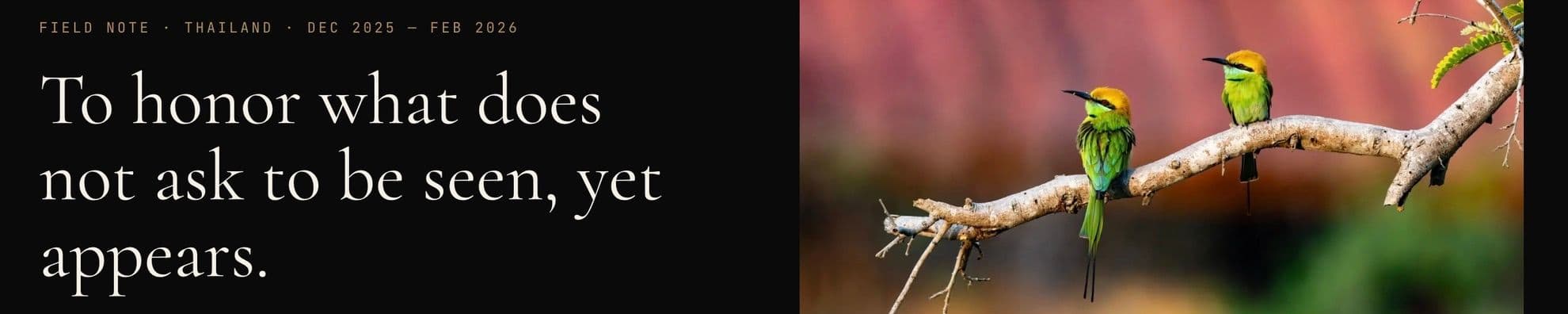
Direction artistique d'une publication wildlife transformée en objet d'archive numérique. Système visuel construit autour d'une palette restreinte — noir profond, parchemin, laiton patiné — et d'un dialogue typographique entre serif éditoriale et mono technique. Chaque image, chaque illustration, chaque texte est traité comme un spécimen sur planche, pour que le site ressemble moins à un portfolio qu'à une revue naturaliste contemporaine.
THE PROCESS
The work began with a refusal — refusing the photographer-portfolio archetype, refusing the flat grid, refusing the assumption that a website about wildlife should look like Nat Geo or like Instagram. We built instead from the idea of an archive: a publication that takes itself seriously, in the lineage of nineteenth-century naturalist atlases but rendered for the screen.
The visual system rests on a restrained palette — deep black, parchment, patinated brass — and a typographic dialogue between editorial serif (Cormorant Garamond) and technical mono (JetBrains Mono). One voice for the gaze; one voice for the data. From that grammar, the site unfolded: a journal of long-form expeditions, an interactive 3D globe charting where France has worked, conversational AI that searches the archive in natural language, immersive species pages built like product pages for the natural world, and a discreet license shop running on Stripe and Cloudflare R2.
Nothing was assembled. Every section was directed — its rhythm, its breathing room, the way an image meets a line of text. The result is a site that doesn't behave like a portfolio. It behaves like a publication that happens to be online.
THE RESONANCE
The site reads slowly, on purpose. Visitors arrive expecting a photographer's portfolio and find a publication — one that asks them to scroll, to read, to look closely at a bird's wing the way a nineteenth-century plate would have asked them to. The 3D atlas turns the act of browsing locations into a quiet exploration. The Ask the Archive bar makes the corpus answerable in plain language. The species pages let a single observation breathe across an entire screen.
For France, the site became less a marketing tool than a working studio — a place where new expeditions accrue naturally, where the work compounds, where the audience that arrives is the audience she wanted: people who came to look, not to scroll past.